It is past midnight on Thursday, October 29, and the final results of the Israeli elections are coming in. It’s a mixed bag of data and emotions. Much remains in the air—still in motion – unclear, unknown.
I am reminded of the wise words of the Talmud: “One must bless the bad news just as much as one must bless the good news.”
It’s always both/and. What is this specific twist about? What are the blessings?
Jetlagged and delirious after long days and little sleep, this note may not be the crispest report, but I want to think aloud, share some thoughts, facts, feelings, and a quarter-baked analysis—linking headlines to our mythic narratives, where I feel we are, how we hope and what will heal—before I unplug for Shabbat, later today. A rest from screens feels sorely needed.
Read it as a thought-in-process: much can shift by the time it reaches your inbox, yet certain truths feel more solid than whatever actual numbers finalize and which and coalition coalesces in the next days or weeks.
The electoral process feels familiar yet confusing and, at the same time, this might just be a historical milestone. The biggest takeaway is the astounding rise of the Arab citizen vote that rocked these elections, defying expectations and potentially rewiring the reality on the ground.
Above all, it is, again, the concept of the AND that matters here most: that tired, indispensable AND I keep returning to as our strongest leg to stand on. The Vav which is the central Trope of Jewish wisdom – the AND that helps us link, expand and heal beyond zero/sum game of familiar borders – good guys vs bad guys; the messy AND of nuance and complexity that might open the bravest new chapter of this ancient-modern moment. It is possible that the extraordinary opportunity will be squandered by petty politics – yes. Yet perhaps we will be supported by political goodwill, surprised by a big leap of faith toward true solidarity among all children of this holy land — and so many other lands as well. We gotta dream.
A few snapshots before I focus on the pivotal political roadmap:
The Funeral
My good friend Tova’s mother died peacefully on Election Day. She was 87, after bitter years of illness. Tova and her siblings had been by her side through long nights, praying for a tender end to her suffering. Tova, who lives right next door to where I’m staying in Jerusalem, shared a mix of relief and anguish when we hugged late Tuesday night after the polls closed and when I heard her news. Beyond grief her immediate anxiety was how to navigate the funeral and shiva with her extended Orthodox, Religious-Zionist family – deeply divided on multiple issues with voting patterns on the entire spectrum.
Will they handle raw feelings and get along as they also process grief?
Tova’s mother was one of those rare big hearts who accepted different ways of being in the world—including Tova’s choices as an unwed mother, queer, rabbi, and left-leaning spiritual activist – with an open-hearted “yes” and a hug, even with speedbumps and long silences. It was always she who brought the stricter father around, too. That generous spirit of acceptance beyond borders was the essence with which she was laid to rest, a sentiment shared by all her children as we gathered in Jerusalem’s main cemetery to pay our respects. In between the eulogies people kept checking their phones for updates on the incoming counting of the votes.
Tova’s fears dissipated. Earlier this evening she shared how the first day of shiva went: across political and religious divides, the family held together. The house of mourning even became a site for others to share their concerns, anxiety over the possible political outcomes, the visible national fissures, a space to listen and discuss what’s next. A few even shared that they voted more toward the center than before—a tiny sliver of shift after years of furious polarization.
Family First
Their family is not unique.
Many families are going through these generational growing pains. This transition won’t be settled in a single election cycle, but there are visible shifts.
I recognize this from my own family, too. The night before the election, I joined a long-standing tradition maintained by my brother Benny and his wife, Noa: an open political debate with their six children and partners, where everyone shares how they plan to vote and why. In past years, arguments were fierce across the left-right spectrum, mostly but not always held together by a “family-first” commitment.
This year felt different. I arrived in Israel that morning alongside tens of thousands of Israelis who flew in to be part of this moment and vote. Benny invited me to join the circle.
We sat around the dining table where we’ve spent so many Friday nights celebrating Shabbat with soup and songs, delving deep into debate and discussion, especially these past painful years.
I discovered that the family now leans largely toward the pragmatic center-left and center-right “change bloc”—labels so blurred they reveal a political system in flux. I was impressed by the thoughtfulness of my nephews and nieces – their political analysis, care for each other, despite differences, all committed to continue the legacy we got from our parents – both Torah AND Derech Eretz Eretz – Jewish life as well as human AND civil virtues, valued equally, no matter what.
Yet, despite high-minded words, we often fail to walk the talk of civil discourse. We fall into traps of ridiculing and demonizing the other. Rage is how our hurt and fear surface—and I am not immune.
Election Day
By the time I reached the polling station in my old neighborhood on Tuesday afternoon, a sudden rainstorm had swept over Jerusalem and puddles were everywhere.
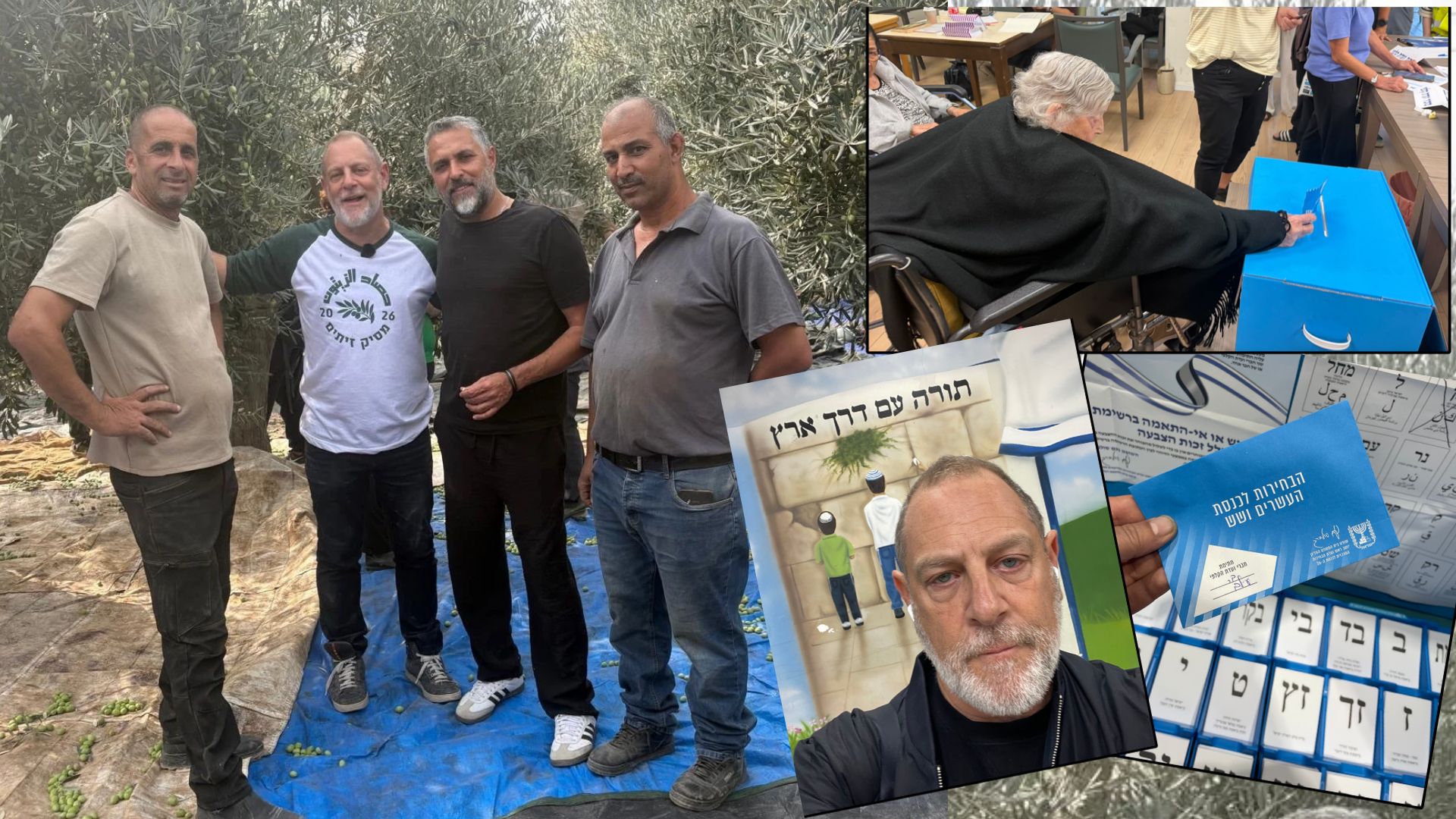
Earlier, our 97-year-old mother woke up eager to vote, and Benny wheeled her to the poll near her home. She did her homework, voted for the candidate most likely to unseat Netanyahu, and was cheered on by neighbors all the way.
I had spent the morning harvesting olives in a Palestinian grove near Bethlehem alongside local farmers and volunteers with Rabbis for Human Rights and Protect the Harvest. As my friend, the singer Ahinoam Nini, who joined me, said: “we chose to start this day and choose to vote for solidarity, hope and common good”.
When I reached the polling station by midafternoon—a religious school I knew from childhood— the rains began and I was drenched.
But it didn’t matter.
Outside, on the street, every party had set up a booth with materials.
Some Likud activists had erected a tent displaying the slogan “Right or Palestine”—the stark either/or paradigm of the past two decades of Bibi’s policy and legacy. As I walked past, looking away in disdain, a young man inside the tent called out, “You better do the right thing!”
Instead of walking on, I lost my cool.
I stopped, looked at him, and asked, “Have you ever helped your mother take out the trash?” “Of course,” he replied.“Well, then you know what it feels like. You are about to become the trash can of history. Bye.”
I walked away under his hail of curses—which I earned. In the moment, I felt a petty smug satisfaction, desperate to believe the old can paradigm was ending. But I am sorry for my words and not proud of that outburst. Taking our rage out on strangers, in person or online just adds fuel to the fire, rarely changing hearts and minds. It was unkind and unwise. The small “wins” of contempt do nothing to heal the culture war. Blindspots keep us blind.
Inside the long line, I overheard an older woman arguing that the far-right Noam party was the only option for an authentic Jewish education. I stayed silent this time, refraining from pointing out that the party’s platform was built on homophobia and exclusion. Right above her hung the school’s slogan: Torah with Derech Eretz. Our childhood motto. Jewish AND Human values. Oh well. I snapped a quiet photo of myself in front of it—grim, but smiling at the irony.
Inside the voting booth, I took a moment to shed a few tears. It often happens. Voting feels like a sacred duty—a step into the Holy of Holies to pray for life and democratic dignity. I picked the slip proclaiming Truth, choosing a more pragmatic vote than my initial top ideological choice — supporting friends who will enter the Knesset –and a long term shift for change. I quietly recited the blessing for the privilege of voting that our Lab/Shul team co-created a few years ago.
I walked out into the rain feeling hopeful, inhaling the scent of fresh earth in the park across the street, remembering the many times I voted here over the years — sat in this park, argued with voters, volunteered to supervise a shift. Well – here we go again — another cycle, another battleground, another twist and turn and vote and hope and shift.
Despite the desire for instant results and decisive dramatic changes – I know by now the road is longer than a news cycle or even a lifetime. Yet every vote and every cycle counts. We must be patient. Which is hard.
By late that night, the exit polls looked promising; by morning, the picture was far more complex. We woke up worried.
The Arab Vote
So far the single biggest, most transformative story of this election cycle is the Arab vote – the highest in the nation’s history.
Nearly 700,000 Palestinian citizens of Israel went to the polls—claiming their right to shape reality against systemic inequality, discrimination, and neglect, in solidarity with the suffering of Palestinians in the West Bank in Gaza, with clear calls for safety, sustainable solutions and a viable peace process.
Representing 20% of the Israeli population, the Arab citizens who voted, asserted their rightful place as equal stakeholders in Israel’s future, securing 18 to 19 mandates. This is a dramatic, historic shift. While the Likkud, retained its fiercely loyal base, the power paradigms among the other parties fluctuated, and the significant Arab turnout alongside the steadfast votes for the four parties of change coalition signals an undeniable demand by half or so of the nation for governance rooted in genuine partnership.
In the aftermath of the judicial reform protests, October 7th, the horrific bloodshed that followed, the ongoing West Bank violence, the ultra-orthodox rifts and heightened societal animosity, this data is significant. We should not be distracted away from these demands for change.
Real Jewish-Arab coalition-building is both a moral imperative AND the only strategically sustainable path toward a democratic future that will course-correct. So much must change.
For that to happen, Arab voters and their elected representatives must be treated not as political threats or temporary pawns, but as essential partners in building an equal shared society.
It’s unclear who will be granted the mandate to form a government. It isn’t just a numbers game. The immediate question is whether the fragile change coalition—spanning center-left to right-wing figures—will have the courage to partner directly with Arab parties to form a viable governing alternative, or fall back into the familiar all-Jewish consensus.
The Ra’am party, under Mansour Abbas’s pragmatic leadership, represents the clearest path away from endless paralysis.
For many Israelis, there’s no distinction between Hamas and Israeli Palestinian citizens. Trauma based suspicions still run deep.
This crisis calls on the change coalition leaders to have a clear voice for change – which most have not claimed yet.
Some suggest that the failure of the opposition to score a decisive triumph stems directly from a lingering crisis of big vision. As activist Moshe Radman Abutbul who did not make it to a top seat in the Democratic party – though pretty close – reflected in the election’s aftermath:
“It’s not demographic factors that screw us up; it’s the cowardly lack of vision, the lack of political imagination beyond familiar history that denies us the option of dreaming big beyond the ultimate reality that ‘there is no partner,’ as dictated by Netanyahu for decades. You ask me what our north star should be? Equality, partnership with Palestinians, and peace. Head high.”
Parties like A Place for All—conceived by leaders from Standing Together as a 50/50 female/male, Jewish-Palestinian political partnership project including LGBT leadership and headed by a woman —did not run this cycle, knowing the threshold was out of reach. But their work continues to build the groundsoil for the next election cycle, meanwhile strengthening their base.
This is one of the manifestations of the visions needed to surface loud and clear.
Progressive movements fail when they operate purely out of opposition; obsessing over authority figures rather than building structural alternatives leaves the public in a vacuum of fear. Navigating this negative requires a shift from nostalgia toward deep structural renewal, listening to the lived experiences of ordinary people and committing to long-term democratic infrastructure that truly honors bigger dreams and goals.
Including Arab political leadership as core architects of governance is the ultimate test of this transformation. I believe it’s the only path forward. Will the leaders have the course to pursue this path or squander this historical opportunity?
What is Trump’s role in this, and how will the midterms impact this process? What are the other factors, fears and fusions of wills that will help guide this political puzzle?
All good questions we will wrestle with for many days to come. Or more?
Revise the Myths
By now it’s 5:00 AM. The Friday sun is beginning to rise over Jerusalem, and I am rushing to complete this note, preparing to brew coffee before returning to another day of the olive harvest in the West Bank. What if we’re attacked again by angry young Jewish settlers who don’t want to see this solidarity? What if the army stops us again? Who knows. But we have to try. Over a hundred volunteers signed up and the farmers need us in order to access the trees. It’s peak season.
We have to show up for solidarity if we want change to manifest – in the polls and in the orchards. In the public squares this Saturday night another massive protest planned to call for a unity coalition that finally welcomes the Arab parties as equal partners – with pride.
That old dove of peace from Genesis with an olive leaf in its beak reminds us – there is always hope beyond the floods of loss. Before the rainbows.
And there is one more myth from Genesis on my mind today.
This Shabbat, the weekly Torah portion brings us back to our foundational narrative: Abraham’s family splits in tragedy, born of scarcity and fear.
A new boy is born to 90 year old Sarah. Yishamel, born to Hagar, is already 13 years old. It’s unclear what happens but Hagar and Yishmael are banished into the wilderness. In this zero/sum story only one boy gets to be the heir. Sarah and Isaac stay on Abraham’s land and maintain the legacy, while Hagar and Ishmael become a footnote.
Either/or fear drives the rift. The Arab-Jewish conflict begins here.
Yet a divine well appears in the wilderness, an answer to the mother’s cries, assuring a future for both lineages. Sarah and Hagar became their people’s matriarchs; both boys become the leaders of their tribes. Yet not together.
Must it still remain this way? Can we offer a new way to tell this tale – the next chapter of our lived tradition that will not choose between the two but honor both?
The sacred story does not end on the parchment. Isaac and Ishmael must not meet only to bury their father as the Torah tells it—they – we – must stand side by side, hand in hand, to overcome generations of exile, feud, and fear. There is enough land and legacy and love.
Why else return to this land if not to realize this family reunion?
Extremism and raw trauma are real. Bad blood is not an illusion. But history reminds us that there is far more that binds us than tears us apart. Our ancestry commands us to become better ancestors to the future generations.
Holding onto the brave, patient faith required to build a shared home is the true Abrahamic promise. This is the time for the new chapter to be written by all of us. If not now – when?
The family – like Tova’s, like mine – like Abraham’s can figure out this feud and rise to the challenge of respect and reunion. Heal the story, change the narrative, fix the feud, feel the fusion fill our lungs with love.
I know. It’s an idealistic cheesy dream while all around most people say that story must remain a war with walls and fences. We know enough to know that every conflict will and can end. This one is no different. It’s only the question of who, when, and how.
We bless the hard truths alongside the fragile hopes. The bad and good news as they weave and combine.
We bless the grief that cracks us open, the rain that drenches our cynicism, and the historic rising voices that refuse to be erased. Beyond the binaries of victory and defeat lies the sacred sanctuary of the AND—where Isaac and Ishmael meet at the well, where olives are harvested by neighboring hands, and where two nations finally choose to share one land, one destiny, and one future.
Tonight I will return to my brother’s table for Shabbat dinner — to pick up where we left off—to his famous chicken soup, to some wine I bought, to deep discussions, and to what our parents taught us: to keep holding space for shared values, combining Torah with Derech Eretz—Jewish tradition with human decency and civil respect. Always both.
And – what next? Time will tell.
Back to NYC on Sunday to vote. Again.
Hope is a muscle.
Here’s hopeful.
Shabbat Shalom.
Rabbi Amichai Lau-Lavie
Lab/Shul Co-Founding Spiritual Leader